
Beyond First Impressions
Five Scholars Reflect on Aspen
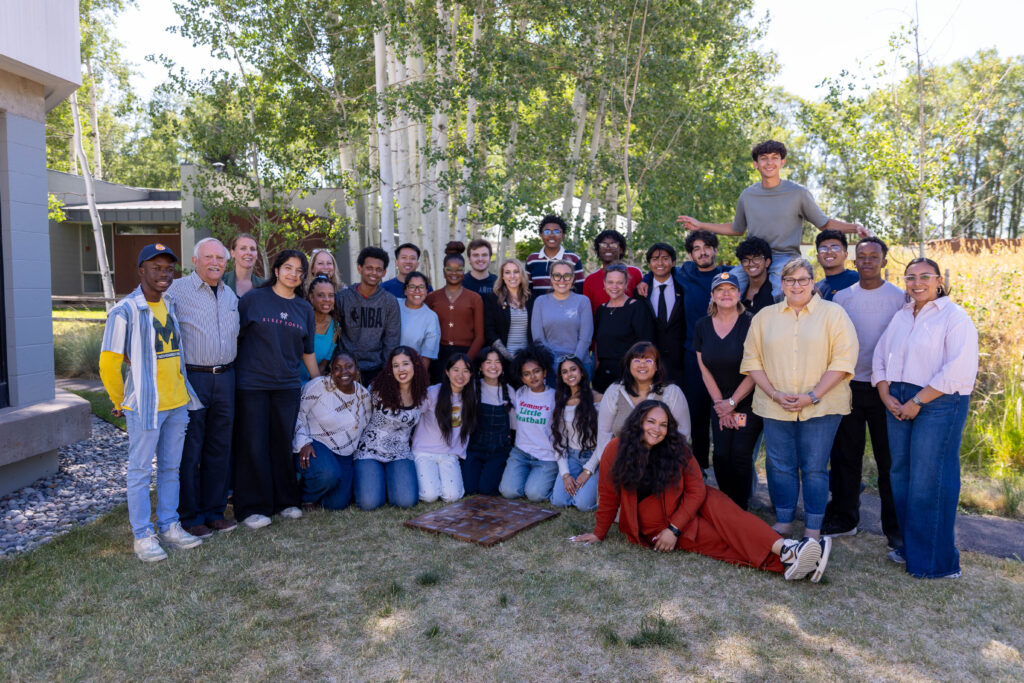
The Bezos Scholars Program journey begins long before Scholars arrive in Aspen, Colorado. Starting in May, each cohort comes together through virtual sessions, workshops, and conversations designed to build community, deepen learning, and strengthen leadership skills. Those connections come to life during a transformative week in Aspen, where Scholars engage with new ideas, inspiring speakers, and one another. In the reflections that follow, five student Scholars share the insights that shaped their experience.
What I’m bringing home from Aspen
By Uche Uwaezuoke
In a space like the Aspen Ideas Festival, where so many brilliant scholars, activists, CEOs, and successful people come together, it is easy to feel like an imposter. Even as a Bezos Scholar, hearing your name recognized during the opening ceremony and feeling proud of your accomplishment, you may still compare yourself to others and wonder, “What could I do for my community that could be as impactful as what these people have done?” By the end of the week in Aspen, my question had shifted from imposter syndrome to a newfound optimism.
Tracie Ching, an artist and activist who was a Scholar speaker while we were at the festival, embodied this sense of optimism. One phrase she shared stayed with me: “Never assume you are going to fail.” As an artist in a digital age, where many fear that art is losing its importance, she remained confident in the value of her work. She used her art and her heart to advocate for political causes she cared about. She also recognized that creating change did not always mean placing herself at the center of a cause. Sometimes, her role was to use her platform to elevate the people whose voices belonged at the forefront. Her story showed me that believing in your abilities is essential but so is knowing how those abilities can create space for others.
“Never assume you are going to fail.”
—Tracie Ching, artist & activist
The next morning, before I had fully understood her lesson, Derek Wang, a concert pianist and Juilliard Creative Enterprise Fellow, created the type of space Tracie was speaking of.
I initially did not sign up for the opportunity to perform at the Juilliard pop-up at the festival. I did not believe that my poetry counted as a performance. When Derek approached the students who had signed up during one of our breakfasts, I sat at their table because I was intrigued. I was immediately pulled into the conversation about the performance. I even remember thinking, “When is the best time to tell him that I actually don’t think I want to do this?”
By the end of the discussion, I had changed my mind and been tasked with writing and performing a poem centered around the Beatles song “Here Comes the Sun.” So, I wrote. A couple of days later, while performing at the festival, my fellow Scholar performers—Jordina, Siddhi, Audrey, and Vunal— sang background music while I read my poem.
After the performance, I received an incredible amount of love. One of our educator Scholars, Kimber, even got a tattoo that represented the optimism the piece was centered on! This feedback made me realize that creating change begins with optimism.
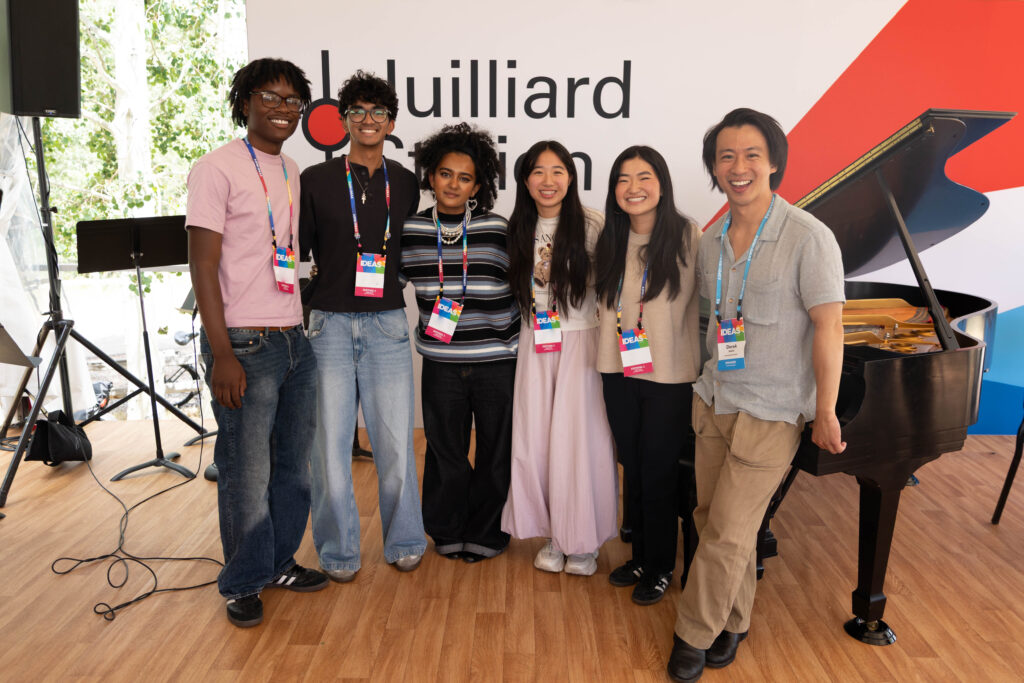
Optimism gave me the courage to participate and recognize the impact my voice could have on others. I will use this mindset when working on my Community Change Project. Embracing uncertainty, maintaining resilience, and being optimistic. I will encourage others to see the value in their own ideas and to act on them with confidence.
That is the lesson I want to take back to my community: Never assume that you are going to fail and remain optimistic about the impact you can create.
Waiting
By Paris Ennyonyozi
While in Aspen, meeting David Brooks—a bestselling author and former New York Times columnist, whose work I’d unknowingly encountered for years—was surreal. He challenged us to have three great adventures every decade. Good things come to those who wait, and I happened to do my fair share of waiting. What I wasn’t waiting for was the way this experience would shift the questions I asked myself. Looking around Aspen, I realized one of my adventures had already begun.
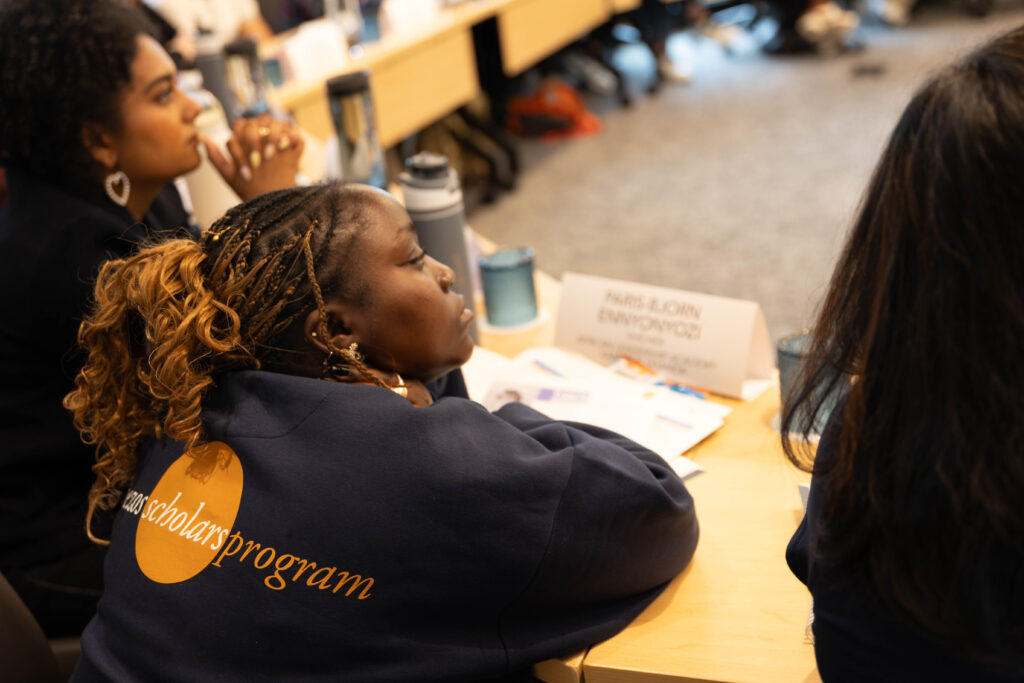
In one of our early activities, Bezos Scholars staff member Adriana, asked us to write our core identities on cut-out paper leaves. As Scholars in the room slowly filled up their leaves, the room also filled up with stories. I began to see the infinite categories I fall under and just as many that I don’t. Growing up in Uganda, a country far from a rainbow nation, gave me a different experience being a young Black girl than those with similar identities in the diaspora. I did not grow up being a minority, and so I hardly thought deeply about what other identities I belonged to, or my strengths and areas for growth. This activity opened my eyes to the reality that identity is never singular. We are all intersections of experiences, histories, and communities, far more than a single label could describe. In doing so, I learned that every part of me deserved to be known, not just the parts I always introduced first. Alongside this, a conversation with a fellow Scholar taught me to tame the assumptions I made in foreign spaces and to be comfortable in who I am, even when uprooted from familiarity.
I also gained a new perspective on individuality, which I learned must co-exist with intersectionality. I was privileged to sit in on a special Scholar-only discussion with Dr. Eddie Glaude, a Professor of African American Studies at Princeton. He educated us on the fugitive slave cause of Moses Gordon, who was found guilty of trying to “steal” his own freedom. He wore a sharp linen suit and will remain etched in our memory. I may not be able to reconstruct what made that time with him so special for others, but I can tell you what I walked away with.
“We see ourselves through the eyes of those who despise us.”
—Dr. Eddie Glaude,
Professor of African American Studies,
Princeton University
I came to see just how easy it is to get swept up in everyone but yourself. To fight for everyone else and slowly abandon yourself until everyone else occupies a larger part of your identity than you do. He challenged me to think beyond the labels we inherit and the ones we self-assign. We speak so much about systems, power, privilege, and rightly so, but we sometimes forget who we are. We are the main characters in our own lives. To ignore that is to miss the most interesting part of being human. One of the benefits of our time with Dr. Glaude was rediscovering my individuality.
Aside from the assumptions people make about you based on your nationality, religion, skin color, political views, who are you? Aspen didn’t leave me with all the answers. It left me with better questions. Intersectionality changed how I ask questions. Individuality changed which questions I ask based on who I’m asking. Indignation changed which questions deserve action beyond just seeking answers. And I think that’s worth every bit of the wait.
Quiet Noise
By Sanaa Al Gburi
To be honest, I dreaded the day I’d return to Texas.
The constant heat wasn’t an issue; it was actually amazing after being frozen solid by the air conditioning needed while indoors. The wind usually had just the right breeze, and an often-escaping scent of someone barbecuing. The issue was the quiet noise that filled my head in between all of that.
My entire life, I felt like an anomaly. Similar to the awkward inner spotlight that comic superheroes or protagonists in teen movies have. When we first moved to Katy, Texas, I remember one of my classmates sharing her aspiration to become an astronaut, and all I could think about was her doing that very thing! But in the span of one “real-world” talk later, she came back with a different aspiration. There was no shame in it; it was still an adventurous endeavor, but that spark in her eyes was gone.
Slowly, one by one, I saw my classmates go through the same process of changing their dreams so that they made sense, were more realistic, and eventually, I longed for everything they were no longer dreaming and sharing. I clung to my aspirations not because they were realistic, but because chasing them felt too much like an adventure I wasn’t willing to give up. But I was confused—didn’t my peers feel that same pull, too? So why wouldn’t they speak their aspirations out loud? Why ignite a dream only to keep it hidden and silent?
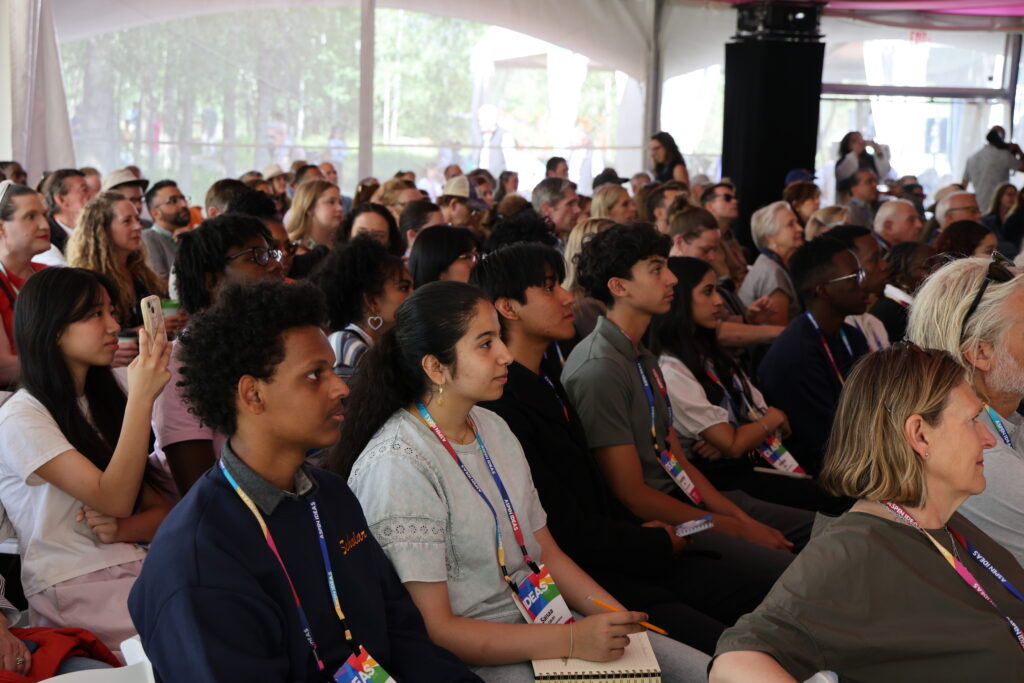
Then came the Aspen Ideas Festival. One festival session in particular reframed everything for me. Dr. Danielle Allen, a Harvard political scientist and professor, spoke on a panel about reigniting American youth through a renewed sense of nationalism, arguing that young people need opportunities to develop a strong sense of pride, loyalty, and commitment to our nation and a shared investment in its future. It was a call to bring young people back into the story of the country.
As I looked at David Brooks, who moderated the session, I was reminded of his opening talk alongside Fareed Zakaria, a journalist and author, who offered something that sat right next to this idea and yet completely against it. This generation’s relationship to nationalism is not a lack of belief waiting to be reignited, but a wound. It is a vulnerability and a disillusionment that comes from watching your voice go unheard for so long that you stop using it, then being surrounded by the hardships that can result from that silence. The speakers weren’t disagreeing so much as looking at young people’s lack of nationalism from different angles.
It was Brooks’s framing that resonated most with me: maybe we don’t recognize that silence as a form of pain because it isn’t adults’ silence to recognize. That’s when it clicked. My friends back in Katy hadn’t stopped voicing their dreams because those dreams had disappeared. They’d stopped because no one had created a space where saying them out loud felt safe, expected, or normal. In the same way, an entire generation’s relationship to its country had been quietly written off as apathy rather than understood as an unrecognized ache.
I once dreaded returning to Texas. Now I know what that “silence” back home actually is: young people protecting the ideas they believed would go unheard. And now I know what it will take to help break that silence. Not a speech, or fancy title, just a room where people are invited in as they are, the same way the Bezos Scholars Program invited each of us into rooms, sessions, and conversations. I cannot wait to help build that space in Katy, where “real-world” talks stop being about scaling down dreams and start being about scaling them up together.
More Than a Blank Canvas
By Siddhi Karthikeya
With our luggage squeezed between us, every scholar leaned toward the windows, trying to capture the green forests, tall mountains, and impossibly blue sky. There was so much green that it seemed Colorado had pushed every other color off the palette.
Then the altitude hit.
Walking up one flight of stairs felt like inhaling an oil-paint solvent. For the first few days, nausea and exhaustion became part of the experience. But every painting has its imperfections, and Aspen’s were pretty minimal.
Being a Bezos Scholar is like being handed a giant blank canvas. The acceptance letter tells you it is yours, but Aspen gives you the colors.
One of the first colors came from political artist Tracie Ching, who spoke privately with the Bezos Scholars while we were in Aspen. She told us that people can suggest the colors in our lives, but they will never hold the paintbrush.
I needed to hear that.
As Scholars, we constantly seek advice because we want to do what is best for our communities. But sometimes, we forget to trust the instincts that brought us here. Others can guide us and add color—which is what the Aspen Ideas Festival is about—but the final stroke remains ours.
The Festival felt like walking into an art store, being told we could take every material we wanted, and then discovering that almost everything was free. CEOs, professors, scientists, musicians, activists, and artists stood in front of us, urging US to ask questions.
Still, the most meaningful part of Aspen was not collecting emails from professors or Pulitzer Prize-winning singers, although I definitely did. Rather, it was the relationships built between Scholars.
These were the people I did the Soulja Boy dance with during our closing talent show, sang Here Comes the Sun with at the Juilliard Pop-up performance, and stayed up far too late talking about our lives, struggles, wins and communities. Their stories made my struggles feel less lonely. Their hopes made my eventual Scholar project feel possible. Every Scholar was there for a different reason, but underneath it all was the same purpose: to make a change.
And while our days seemed to hold years and our nights disappeared in seconds, one thing was certain: the memories we made would last a lifetime.
While Aspen gave me speakers, opportunities, ideas, and a much larger palette. Scholars gave my painting meaning.
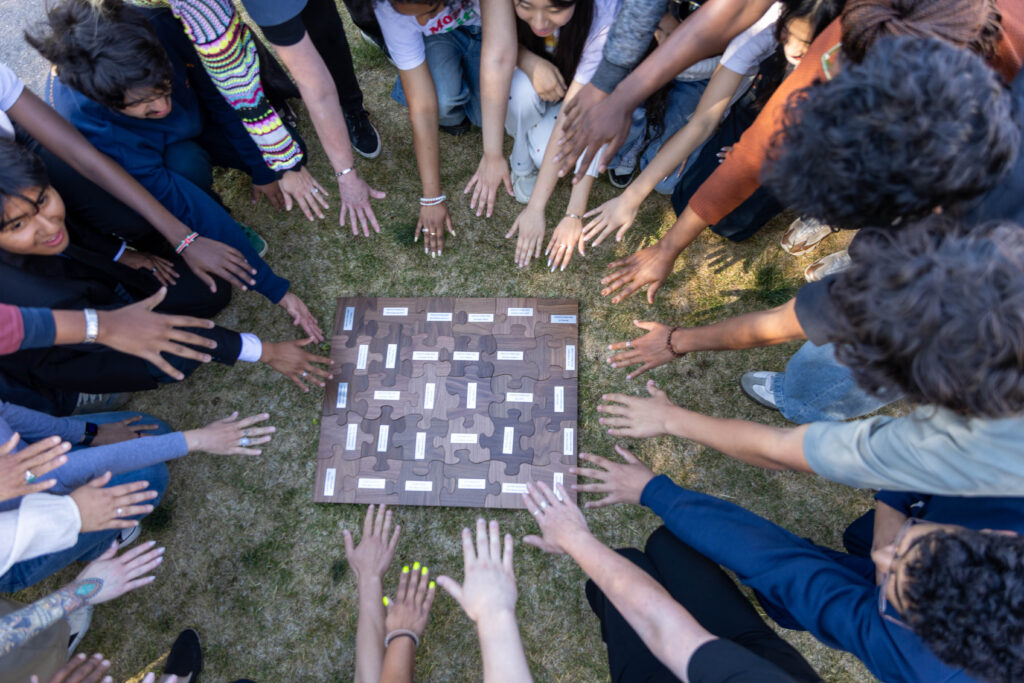
Scholar Portraits
By Alae Sidi Mohamed
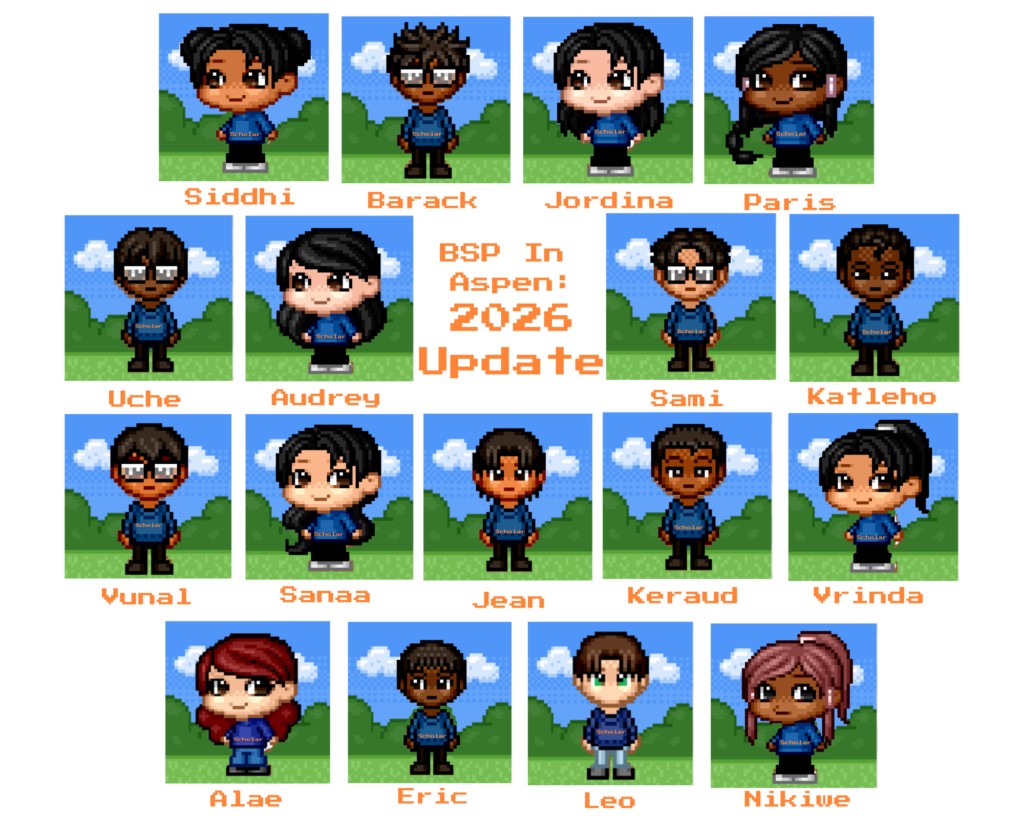
Alae created this graphic as a fun and playful way to highlight each of her fellow student Scholars in. As she reflected, “From a bird’s-eye view, the students in the cohort seem to be complete opposites. While in Aspen, I learned that we have far more in common than I initially thought. I give each of them credit for the wake-up call they gave me, and for helping shatter the binary through which I used to view new people.”
We want to extend our sincere gratitude to the Scholars whose experiences, insights, and voices helped shape these reflections. We are also deeply thankful to the many partners in Aspen who welcome, support, and care for Scholars each year, making this experience possible. We are especially grateful to Mike Bezos and to the enduring legacy of Jackie Bezos, whose vision, generosity, and belief in young people’s potential continue to shape the Bezos Scholars Program. Thousands of young leaders have been inspired by the opportunities they helped create, and we remain honored to carry that legacy forward.