Celebrating 2025 Scholar Community Change Projects!
Introducing the 13 projects launched by the 2025 Bezos Scholar Cohort.
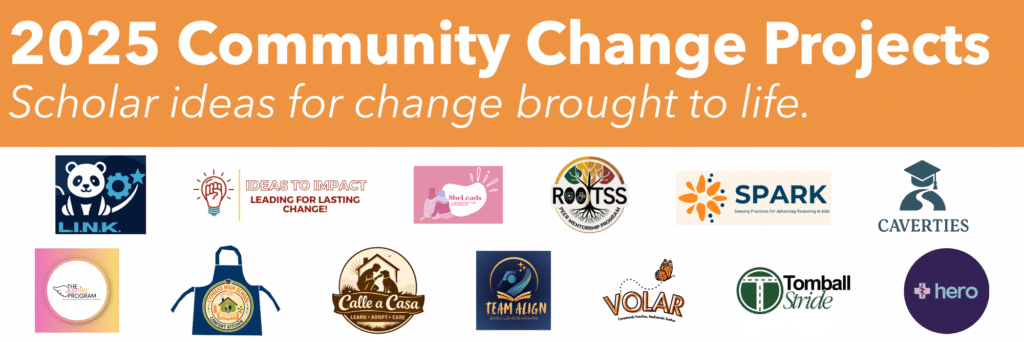
Over the past nine months, members of the 2025 Bezos Scholar cohort have been building their Community Change Projects from the ground up. Along the way, they’ve collaborated closely with peers and mentors, adapted to challenges, and stayed focused on the goals that matter in their communities. The result is a collection of projects that reflect both creativity and deep local insight. Each one responds to a specific community need and carries the voice and vision of the Scholar behind it.
Every project is supported with $1,000 in grant funding, renewable annually. For the Bezos Family Foundation, this investment represents more than financial support. It’s an expression of confidence in young people’s leadership and their ability to turn ideas into meaningful action.
In late January and early February, Scholar teams shared their work through virtual presentations with the BSP community, as well as family members, friends, and project partners. Recordings of these presentations are linked below, offering the opportunity to hear directly from Scholars about their motivations, progress, and next steps. We’re inspired by the thoughtfulness and commitment of this cohort and are proud to help uplift their work. We invite you to join us in celebrating these student leaders, the educators who support them, and the broader teams helping bring these projects to life in communities across the country.
New Community Change Projects Founded by 2025 Scholars
ASPIRE Program (Achieving Success through Purpose, Inclusion, Respect, and Engagement)
Community Need: Students transitioning from middle school to high school need opportunities and encouragement so that they get involved in school activities and events outside the classroom.
Target Audience and Location: Middle school students at Canandaigua Middle School who plan to attend Canandaigua Academy in Canandaigua, NY.
Vision: We envision a school culture where every student feels connected and empowered to contribute to a vibrant and thriving student body.
Mission: To help students develop leadership and problem-solving skills through activities that deepen middle school engagement and prepare them for high school, making it a friendly, inclusive environment for all.
Project Description: Scholar Lindsey LeTran and her educator, Ashley Fisher, co-founded ASPIRE, an initiative designed to support a smoother transition into high school through leadership development and inclusive engagement. The project brings together students, educators, and school partners to design and lead leadership workshops, collaborative work sessions, and a culminating activities fair. With support from partners including Student Government, the PTSA, and Unified Sports, students take on meaningful responsibilities ranging from outreach and logistics to curriculum design, using reflection and feedback to strengthen the program and guide future iterations.
As a student leader, Lindsey is most proud of “my team for stepping out of their comfort zones. Each person has taken on something they weren’t initially confident in, whether that meant stepping into new leadership roles or finding the confidence to use their voice.”
Calle a Casa
Community Need: Education about the behavioral and emotional challenges shelter animals face, to increase the likelihood of successful adoption.
Target Audience and Location: Cats and dogs at the El Paso Humane Society awaiting adoption, and those wanting to adopt shelter animals in the El Paso, TX area.
Vision: A compassionate community in which every shelter animal is safe, nurtured, and adopted into a loving home.
Mission: To increase permanent adoptions from El Paso animal shelters by mobilizing volunteers and resources that educate the public about the behavioral and emotional needs shelter animals have.
Project Description: Scholar Isabella Villalobos and educator Javier Rubio co-founded Calle a Casa, a project developed in partnership with the Humane Society that brings together students, educators, and animal welfare professionals to design and pilot community-based educational strategies supporting shelter animals and adoption efforts. Guided by shelter staff, the team has collaborated to identify outreach approaches, build partnerships, and plan programming that connects community members with accurate information and resources related to animal care. As the project moves forward, the team is excited to use their grant funding to support the Humane Society’s mission to prevent suffering, neglect, abuse and cruelty to animals, by providing information, raising public awareness of animal issues, and promoting responsible guardianship and kindness toward all living things.
As a student leader, Isabella is most proud of “the partnership I fostered with the Humane Society and how far I have come on this project. I am also proud of my team for being open-minded, understanding of my vision, and being there for me and one another.”
Caver Ties
Project Focus: Expanding access to college readiness resources for first-generation college students.
Target Audience and Location: Sophomores and juniors at San Diego High School (whose mascot is The Cavers) who will be the first in their family to go to college, and current local college students who are also first-generation college students.
Vision: A future where every first-generation student attends and successfully graduates from college, gaining access to further opportunities, achieving financial stability and supporting and uplifting their families.
Mission: High school students who are first in their families to go to college are equipped with the confidence and connections they need to successfully navigate the college application process through supportive mentoring from first-generation college students.
Project Description: Scholar Liya Getahun and her educator, Jennifer Pickering, co-founded Caver Ties, a mentorship initiative that connects future first-generation high school students with first-generation college mentors to support college readiness. Structured with clear student leadership roles and guidance from community and higher education partners, including First-Generation Scholars and advisors from UC San Diego, the project focuses on mentor recruitment, program planning, and sustained relationship-building. Through regular mentor–mentee sessions and ongoing feedback, the team is strengthening the program over time, reflecting care, persistence, and a commitment to building meaningful pathways to college success.
As a student leader, Liya is most proud of “how our team worked collaboratively to engage our school’s first-generation community and the project around what students actually want and need. Through information gathered from a student-led survey, my teammates brought intention, empathy, and leadership to every step, ensuring this project is truly built by and for students.”
Comfort Kitchen
Community Need: Creating equitable access to nutritious food when at school so students can fully engage and succeed.
Target Audience and Location: Socio-economically disadvantaged students attending Cypress High School in Cypress, CA.
Vision: A future where every student has reliable access to filling, nutritious food during the school day, so students have the fuel they need to learn, connect, and thrive.
Mission: We cultivate access to nutritious food on campus for economically disadvantaged high school students through an on-site pantry that provides free, reliable meals in a way that honors students’ dignity and choice.
Project Description: Scholar Parsmi Rajput and educator Shelley Hawkins co–founded Comfort Kitchen, an initiative focused on creating and sustaining an on-campus food pantry. Over the school year, the team has built a structured leadership model, secured district and community support, and navigated the planning and approval process to prepare a pantry space that is organized, accessible, and designed to preserve student dignity. Supported by a cross-grade student team and community partners, including the district’s Teachers Union, the project is now preparing the pantry space, developing outreach materials, and establishing systems to track usage and gather feedback, with sustainability and leadership transition guiding its continued growth.
As a student leader, Parsmi is most proud of “myself for completing my grant proposal and going step by step instead of trying to do everything at once. I am also proud of my team for coming together and establishing roles so we all play an important part in the project’s success.”
HERO MD

Community Need: Increasing resources for students to get interested in careers in the medical field to increase the number of quality medical providers.
Target Audience and Location: Students at San Jacinto High School and San Jacinto Leadership Academy in San Jacinto Valley, CA.
Vision: A future where young people across the valley thrive and are confident in becoming compassionate healthcare leaders.
Mission: To educate young people about healthcare careers by raising awareness through community events and social media engagement.
Project Description: Scholar Turner Daudert and educator Priscilla Grijalva co-founded HERO MD, a community-based initiative focused on building exposure, mentorship, and learning opportunities to get students interested in healthcare careers. The project brings together a student leadership team, school staff, and healthcare partners such as the Riverside County Medical Association to coordinate career fairs, presentations, and mentor–mentee connections with local healthcare professionals. As the project moves forward, the team is recruiting and onboarding mentors, pairing students with professionals, and hosting informational sessions and events, using reflection and feedback to strengthen relationships and guide future growth.
As a student leader, Turner is most proud of “my team for being committed to our cause and planning events even when classes are getting tougher, and their schedules get busier.”
LINK (Learning, Innovation, Networking & Knowledge)
Community Need: STEM access and representation
Target Audience and Location: High school students in the New Caney ISD District, particularly Porter High School students in Porter, TX.
Vision: A community where every youth sees themselves within the field of STEM because opportunity should belong to everyone.
Mission: To create inclusive STEM learning opportunities for high school students through mentoring and activities that encourage them to explore new ideas, build confidence, and gain authentic recognition for their work.
Project Description: Scholar Euphoria White and her educator, Autumn Dowdy, co-founded LINK, a school and community-based initiative that connects students with mentors, hands-on STEM experiences, and professional networks. The project brings together a student leadership team, educators, and partners such as the University of Houston, University of Texas PALs programs, GripTape, and Engineering Tomorrow to coordinate mentorship, workshops, guest speaker sessions, and experiential learning opportunities. Through structured mentor–mentee engagement, collaborative STEM activities, and ongoing reflection, LINK focuses on building skills, confidence, and sustained connections that support students’ continued exploration of STEM pathways.
As a student leader, Euphoria is most proud that “she was able to connect with a previous Scholar from her area for collaboration and advice and that her team established a partnership that provided them with over 450 STEM activity kits for students!”
ROOTSS (Reaching Out to Our Talented Scholars in STEM)
Project Focus: Academic support and community for Black students enrolling and persisting in Advanced Placement and college-level STEM Courses.
Target Audience and Location: Black students in grades 9-12 at John Bowne High School, in Flushing, Queens, NY.
Vision: A school culture where Black students feel confident and supported to enroll in advanced placement, College Now, and Ed Equity S.T.E.M. related courses at John Bowne High School.
Mission: Our mission is to provide a student-led mentorship program that increases Black student enrollment in Advanced Placement, College Now, and Ed Equity STEM courses.
Project Description: Scholar Sally Awuku and her educator, Felicia Bifulco, co-founded ROOTSS, a mentorship initiative designed around peer connection, academic support, and community building. The project pairs upperclassmen enrolled in advanced STEM coursework with younger Black students who have not yet engaged in advanced classes, creating structured opportunities for mentorship, relationship-building, and shared learning. Supported by school leaders and community partners such as It Takes a Village and district equity leaders, the team is recruiting and matching mentors and mentees, hosting orientation and bonding events, and facilitating ongoing gatherings, while incorporating reflection and feedback to strengthen relationships and guide future programming.
As a student leader, Sally is most proud of “my team for their advocacy on behalf of R.O.O.T.S.S. within our school community and for their consistent efforts to uplift and share the impacts of our work.”
She Leads
Community Need: Young Muslim girls need meaningful connections with female leaders who can support them in achieving their personal and community goals.
Target Audience and Location: Muslim girls, ages 13 to 17, who attend the Guiding Light Mosque in Louisville, KY.
Vision: A world where young Muslim women are empowered and visible leaders in their community.
Mission: To develop the next generation of Muslim women by connecting girls with strong role models and opportunities to increase their leadership skills.
Project Description: Scholar Mariam Kandel and educator Tonya Swan co-founded She Leads, a leadership workshop initiative developed in collaboration with community partners at the Guiding Light Mosque. The project brings together student leaders, mentors, and professional Muslim women to plan and host a multi-session leadership workshop series that includes speaker panels, small-group discussions, and reflection activities. Supported by partners such as Interfaith Paths to Peace and the Muhammad Ali Center, the team is coordinating logistics, speakers, and family engagement opportunities to create spaces for mentorship, skill-building, and connection, while using participant feedback to inform learning and strengthen the program over time.
South African Ideas Festival – Leading for Lasting Change
Since 2011, the Bezos Scholars Program has cultivated a committed partnership with the African Leadership Academy (ALA) in Johannesburg, South Africa. ALA draws students from across Africa, and every year, they select a small team of students and one educator to plan the annual South African Ideas Festival (SAIF). Each year, the team chooses a theme to focus on their efforts and impact on.
Community Need: Youth need accessible, practical platforms that nurture their leadership and entrepreneurial potential by equipping them with the skills and resources necessary to turn their ideas into sustainable projects or ventures.
Target Audience and Location: Youth aged 16-21 years old from different socio-economic backgrounds, generations and societal backgrounds residing in Johannesburg.
Vision: Generating a prosperous Africa driven by empowered young African leaders.
Mission: To train young changemakers to create a positive impact in their communities through entrepreneurial skills and mentorship so they can lead projects that transform their communities.
Project Description: Scholars Lubanzi Tsabedze, Anotidaishe Chinyadza, Abigail Maina, Elvis Chacha, and Marwa Kriraa, along with their educator Catherine Delight, hosted a series of festival events at their school, designed to engage youth from nearby townships, providing food and transportation to support participation. Working alongside a team of ten student interns, the group developed this year’s festival around the theme “Leading for Lasting Change,” facilitating workshops that build leadership and social entrepreneurial skills paired with mentorship and structured support, so young people can begin to see themselves as changemakers, developing an idea that meets an urgent need in their community.
As student leaders, the ALA Scholar team is most proud of “deciding to trust the process, learning that an idea only seems too big to accomplish until you try it out.” Every participant will pitch their idea, and five will receive start-up funding to bring their projects to life.
SPARK (Sensory Practices for Advancing Reasoning in Kids)
Community Need: Elementary students need accessible, sensory-based math materials and training that enable their academic and social success.
Target Audience and Location: Neurodivergent and general education classroom elementary students and teachers at Stone Lakes Elementary School in Orlando, FL.
Vision: We envision a future where every elementary student confidently understands and enjoys math in inclusive classrooms where every child succeeds.
Mission: We equip elementary schools with sensory-based math resources and connect teachers with training opportunities so that classrooms and learning are more accessible for neurodivergent students.
Project Description: Scholar Nathan Kwok and educator JulieAnne Halsey co-founded SPARK, a school-based initiative that partners with Stone Lakes Elementary to design and pilot sensory-based math resources for classroom use. The project brings together a student leadership team, elementary educators, and community partners to develop hands-on math activities, assemble reusable classroom kits, and create lesson guides that support inclusive instruction. Working closely with teachers and instructional coaches, the team is implementing activities, gathering feedback, and refining materials to strengthen classroom engagement and support long-term use across multiple learning environments.
As a student leader, Nathan is most proud of “establishing a partnership with a local elementary school and a strong team that is enthusiastic and has a lot of great ideas.”
Team Align
Project Focus: To provide students with personalized support and opportunities to explore their purpose, set meaningful goals, and leverage school resources to achieve them.
Target Audience and Location: Freshmen and sophomores who attend Governor Thomas Johnson High School in Frederick, MD.
Vision: A purposeful and supportive school environment where students feel empowered to plan for their future.
Mission: To encourage students to fulfill their purpose by building connections, introducing them to career and extracurricular opportunities, and boosting confidence in their potential.
Project Description: Scholar Jeslyn Kamga and her educator, Natalie St. Fleur, co-founded Team Align, a school-based mentorship and engagement initiative that brings together students, educators, and school partners to strengthen connections between coursework, future pathways, and personal goals. Structured around a team model that includes peer mentors, underclassmen apprentices, and adult advisors, the project is supported by partners such as the School Improvement Plan Team and the Necktie Club. As the program rolls out, the team is launching a pilot mentorship program, hosting purpose-focused workshops, and planning a career fair and educational pathways showcase, while using participant feedback to guide ongoing improvement and strengthen coordination across the program.
As a student leader, Jeslyn is most proud of “presenting at my school’s School Improvement Plan (SIP) team meeting and securing a partnership with them while getting my teachers and admin excited and willing to help with my project.”
Tomball Stride

Community Need: Building community awareness so residents can advocate for a safer and more walkable infrastructure.
Target Audience and Location: Tomball High School community and those living close to or commuting around Tomball High School in Tomball, TX.
Vision: We envision a walkable, green Tomball where every resident can access needs and opportunities without a car.
Mission: We promote safe, accessible walkability for the Tomball High School community through student-led public education and local advocacy.
Project Description: Scholar Shaurya Kante and educator Tiffany Clyde co-founded Tomball Stride, an initiative focused on raising awareness, building partnerships, and fostering civic engagement around walkability in their hometown. Organized across strategy, marketing, community organizing, and networking roles, the team has established an operational structure and secured key community partnerships to support sustained advocacy. As the project moves forward, they are conducting a walk audit and hosting a public town hall in coordination with local leaders, using data collection, storytelling, and coalition-building to strengthen collaboration and support long-term community impact.
As a student leader, Shaurya is most proud that “I developed a strong relationship with our fiscal sponsor and a strong timeline for our project and that my team has chosen three of our core team tenets that will guide our decision-making.”
VOLAR (Voces, Orgullo, Lengua, Amor, Raíces)
In Spanish, Volar means “to fly,” and their acronym in English stands for: Voices, Pride, Language, Love, Roots
Community Need: Building belonging and stronger family-school partnerships.
Target Audience and Location: Hispanic families with K–5 students at Adairsville Elementary School in Adairsville, GA, prioritizing those in the English Speakers of a Second Language program (ESOL).
Vision: Schools build trusted partnerships with Hispanic families, so they feel seen and valued, and every child thrives emotionally, socially, and academically.
Mission: To cultivate belonging and meaningful participation by uniting Hispanic families and educators through trust-building, celebrating cultural identities, and providing bilingual resources that promote student success.
Project Description: Scholar Vivian Reyes and her educator, Emily Thompson, co-founded VOLAR, a school- and community-based initiative at Adairsville Elementary School focused on strengthening relationships between families, educators, and community partners through bilingual engagement. The project brings together students, school staff, translators, and parent leaders to plan and host a series of family gatherings, develop bilingual resource materials, and coordinate culturally responsive events that foster connection and trust. Through consistent collaboration, reflection, and partnership with organizations such as Intercultural Fest, VOLAR centers shared learning, cultural pride, and sustained family–school collaboration.
As a student leader, Vivian is most proud of “how willing everyone on my team is to show up and value real conversations, even when we all come from different backgrounds. They listen, share and care about the families we’re working with, and that’s made our project stronger!”
We are proud of all these Scholars, their teams and the projects they developed to positively impact their communities! Scholars are diligently working to complete their projects before graduation and ensure they are sustainable. Our goal is for projects to continue for years to come, evolving as new student leaders and adult supporters carry them forward with continued funding support from the Bezos Family Foundation. To learn more, visit the Community Change Projects page on our website.